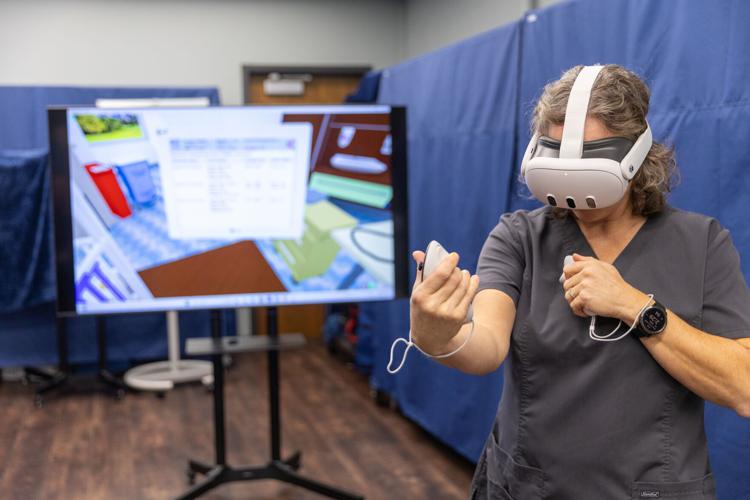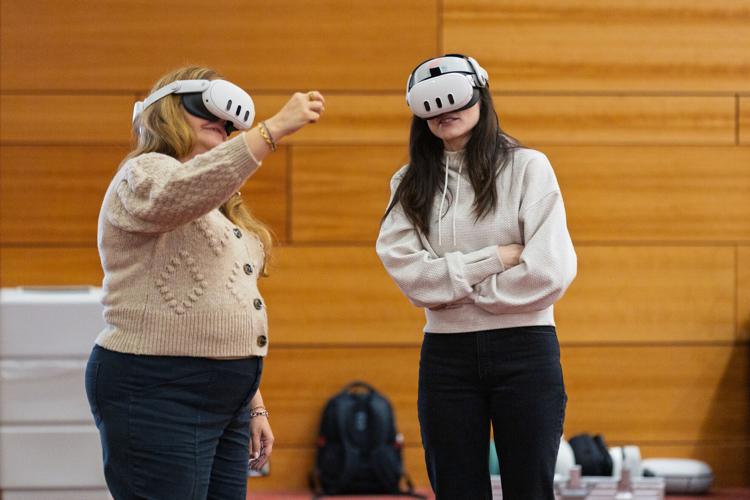



At Valparaiso University, students of the College of Nursing and Health Professions are taking their learning to the virtual world. Thanks to cutting-edge software, these future healthcare professionals are experiencing simulated scenarios and exploring the mechanics of the human body in ways that would be impossible to replicate in the real world.
“Giving our students the most advanced learning tools available is going to go a long way in making sure they’re prepared to meet the challenges of real-world healthcare,” said Elizabeth Gmitter, Ph.D., PT, MS, dean of the College of Nursing and Health Professions at Valparaiso University. “It reflects our programs’ dedication to providing the best student experience possible and our determination to remain at the forefront of healthcare education.”
In 2023, the faculty attended the International Nursing Association for Clinical Simulation and Learning Conference as part of a Health Resources and Service Administration grant. There, they observed a variety of virtual reality demonstrations and eventually elected to partner with medical training company SimX to bring that technology to the university’s nursing and physician assistant programs.

In the classroom, VR often takes the form of collaborative sessions with in-depth, virtual patients. Nursing classes in the virtual space can involve a group of students working in the program, another group observing them, a professor acting as the physician for consultation and a simulated patient who can be asked questions and who has real-time vitals like breathing and heartbeats to be examined.
Healthcare professionals also must be prepared for the unexpected, and the SimX software provides those curveballs, allowing students to have their first experiences in a safe, controlled environment. Nursing major Soniya Ottayil, class of ’26, recalls one such memorable event: a “patient” going into sudden cardiac arrest.
“I didn’t really see the patient go down, I was doing something else,” she said. “I was flustered, walking around, not knowing what to do, and that’s a good experience to have virtually. I obviously wouldn’t want to do that in the real world. It was nice to experience how I would react in such a circumstance.”

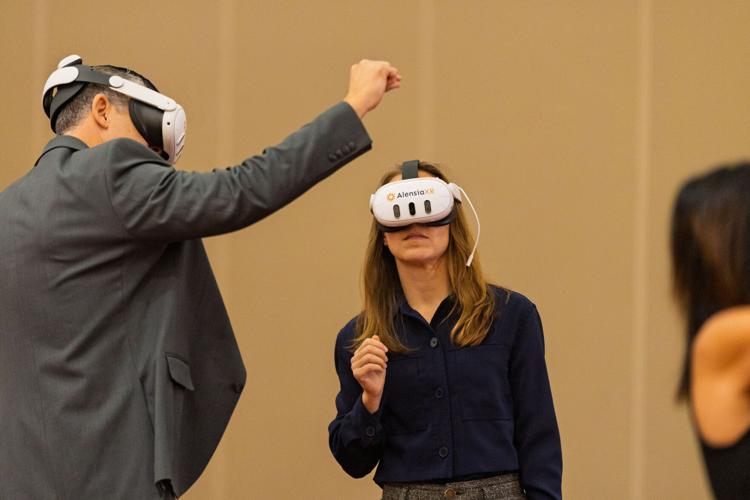
More recently, Valpo has partnered with AlensiaXR, bringing their extended-reality HoloAnatomy NEXT program to the classroom. Extended reality refers to a combination of virtual, augmented and mixed-reality programming and can be used to examine organs and bodily systems without the need for cadavers or dissection.
On Nov. 11, Valparaiso University hosted an event to demonstrate the technology to other professionals and educators. There, participants got to experience firsthand just how these advanced learning tools are helping reshape the way human health is taught.
“It’s extremely immersive. It lets you dive deep into how the human body functions,” said Knut Lovhoiden, simulation technology specialist with Lake Michigan College, after attending the demo. “It’s kind of incredible.”
By adopting these technologies for classroom use, Valparaiso University is staying on the cutting edge of healthcare education, ensuring the best care possible in the future. For more information on those and other programs, visit valpo.edu/conhp.