

Trains are ubiquitous in and around Chicago. The railroads and city grew symbiotically, and no one — particularly along Lake Michigan’s South Shore — is immune to their presence, both in nostalgia-tinged memory and while facing the challenge of daily navigation.
But the railroads also occupy a “parallel universe,” in Geoffrey Baer’s description, a network that transports people, products and commodities at a scale and complexity often unseen and underestimated.
Baer’s new television show for Chicago’s WTTW, “Riding the Rails with Geoffrey Baer,” explores all of that in a portrait of Chicago as “America’s railroad capital.” The one-hour show ranges from tales of well-appointed passenger trains and their place in America’s social history, to the modern movement of shipping containers, carrying the products of everyday life, to the city-suburb flow of travelers and commuters along the modern transit system.
People are also reading…
Baer, known for his collection of city- and suburb-based public television shows that serve as history lessons and travel guides, said in a recent phone interview that he aims “to do programming where people learn things that they never knew, about things that are familiar, but they really didn't know the story behind.”
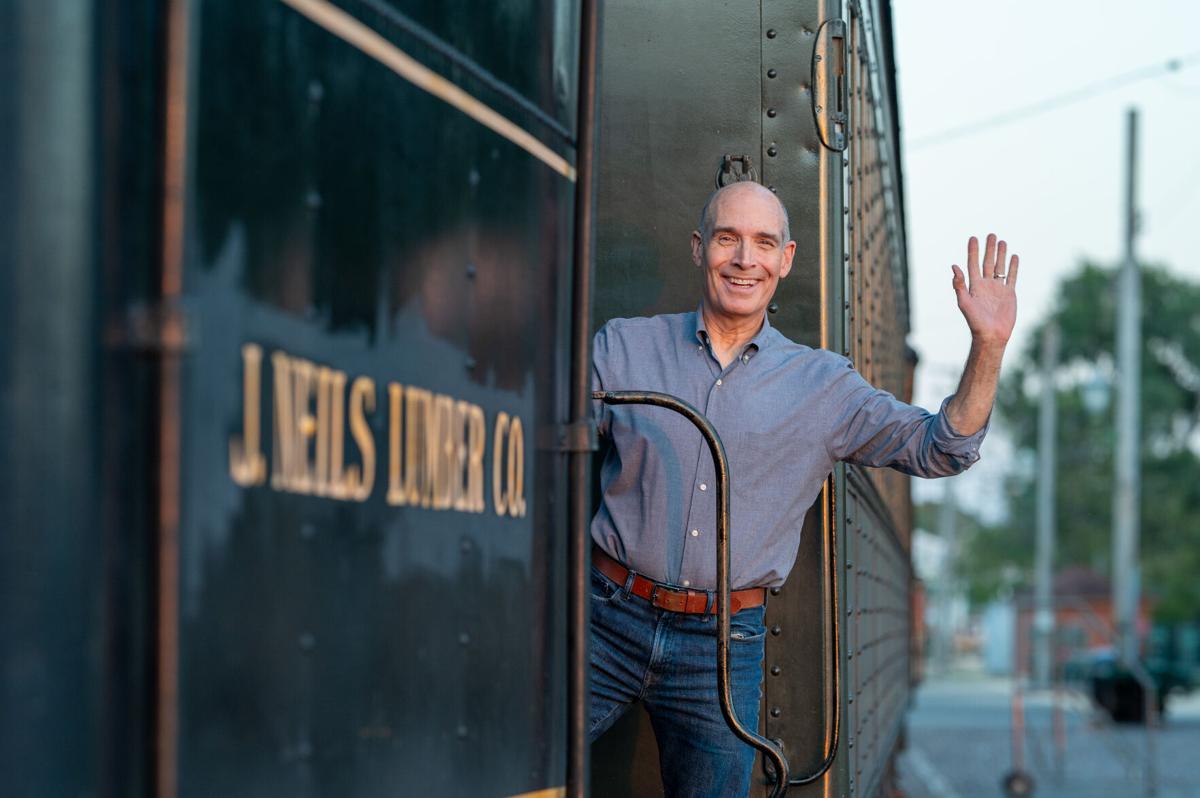
For Baer, “Riding the Rails” was a “bucket list” project, one that explores a lifelong fascination with railroads that began during his youth in Highland Park, when he’d run to the window to watch trains passing near his house. The show begins at a childhood favorite — the Choo-Choo restaurant in Des Plaines, where food is delivered aboard model trains — and ends with Baer satisfying a childhood dream — driving a steam locomotive at the Illinois Railway Museum.
In between, “Riding the Rails” focuses on three aspects of the industry.
Passengers, freight and transit
“The first part is the great heyday of passenger rail,” Baer said. That includes the refined, and at times glamorous, nature of early- to mid-20th century train travel, as well as railroads’ role in social history, including the work of Pullman porters and the importance of a train like the “City of New Orleans,” which helped make the Great Migration possible.
The second chapter covers freight, “a related industry, but not at all the same.”
The freight railroads are what make Chicago the railroad capital of America, Baer noted, stretching back to a time when the south Loop was essentially a giant rail yard, and the Illinois Central came right up the lakeshore. Today, he visits the CSX container yard tucked away in Bedford Park, and the 1.5-mile-long 75th Street railroad bridge project that’s part of a decades-long project to ease rail congestion.
The third “chapter” is transit, Baer said, “starting with horse-drawn street rail.” Cable cars, trolleys, the L, with its “tree-top views of the neighborhoods,” and the interurban lines are all part of the story.
The South Shore Line
In Chicago’s case, the interurbans connected cities along the southern and northern shores of Lake Michigan, and into the Fox Valley. Among the originals — the North Shore Line, the Chicago, Aurora & Elgin, and the South Shore Line — the latter is the last one running.
The South Shore’s Jason Glass and Nicole Barker met Baer on his trip to the Region, and are featured in “Riding the Rails,” which heads south from Millennium Station to Beverly Shores, “a gem of a station,” Baer said.
The station was built when Samuel Insull ran the South Shore, along with the other interurbans, in the hope the suburban development the railroads might support would add customers to his real business — electricity, as president of Commonwealth Edison.
While Insull’s dream came to naught as the Great Depression set in, the railroad continues to operate and grow today.
Riding the Rails
Insull is one of “Riding the Rails’” colorful characters, along with Charles Tyson Yerkes, who was responsible for development of what’s now the L, and a band of bank robbers who pulled off — for a while — the largest railroad heist in American history.
Architecture is also prominent in “Riding the Rails,” in the form of Union Station, the Ogilvy Transportation Center and the L itself, among other features of the metropolitan landscape.
A show like “Riding the Rails” takes months of research, followed by about one month of filming, then several more of editing, Baer said.
While some of that filming, and the resulting documentary, includes the “rail fans” who spend unusual amounts of time immersed in the world of railroads, “we really tried to make this a kind of show that would have very broad appeal to a broad audience,” Baer said.
“Riding the Rails with Geoffrey Baer” premieres at 7 p.m. Monday, April 13 on WTTW, as well as on the PBS app and at wttw.com/rails.
View a trailer at youtu.be/RDjhJFPQuN0.