

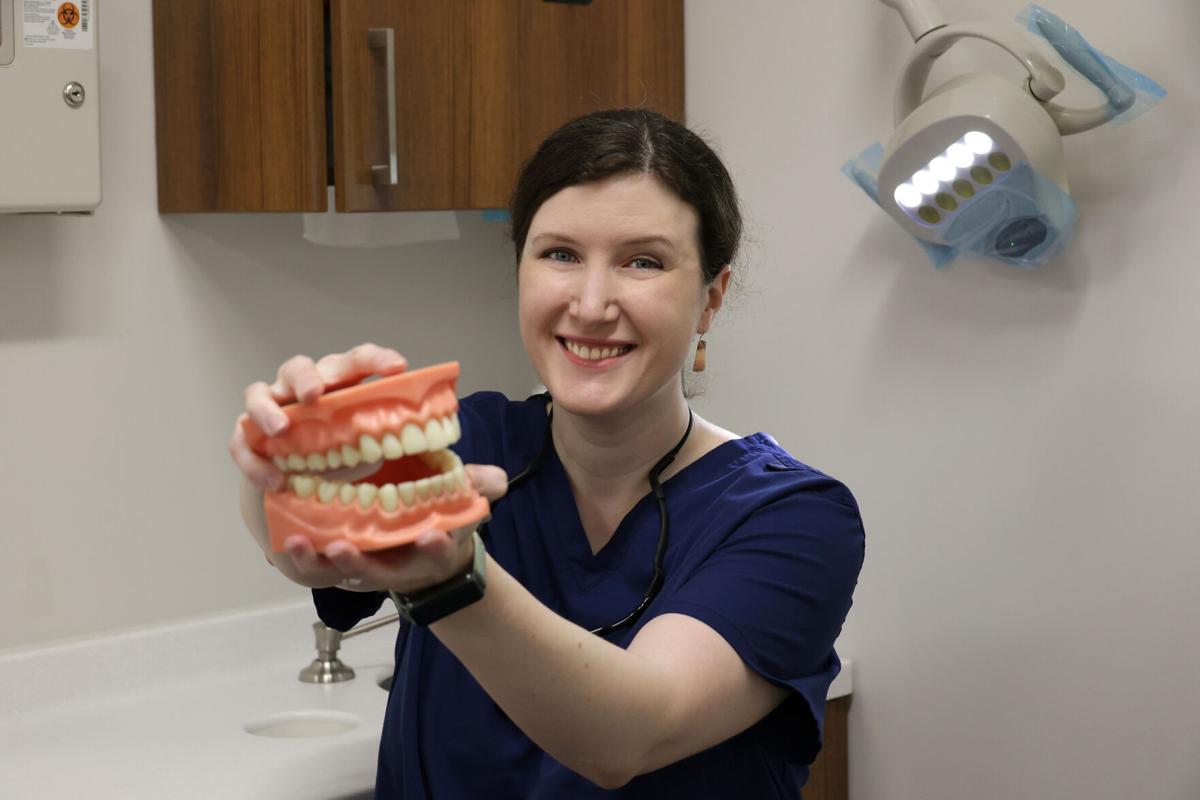
Dr Amelia Blaser, a dentist at NorthShore Health Centers, offers tips for brushing and flossing.
When it comes to brushing your teeth, just a little dab of toothpaste will do ya.
“You do not need a lot of toothpaste when brushing,” says Allison Papp, a dental hygienist at Advanced Dental Concepts with offices in Crown Point. “Just a pea-sized amount is fine.
"It’s more in the mechanical movement and proper brushing that makes the biggest difference in plaque removal," she says. For best mechanics, Papp recommends using an electric toothbrush and changing brush heads frequently.
Dr. Emilia Blaser, a dentist at NorthShore Health Centers, agrees about the pea-size amount of toothpaste but adds: “For children age 3 and under, use a small smear of toothpaste about the size of a grain of rice.”
While the American Dental Association recommends using a fluoridated toothpaste for all age groups, Blaser suggest that parents monitor their children closely while brushing to ensure they don't ingest too much fluoride, which can lead to gastrointestinal issues.
Flossing is another important tool for dental hygiene.
“As far as I know, there have not been any scientific studies done that prove there is a particular order you should be brushing and flossing,” says Blaser. “However, from my experience, there may be a slight advantage in flossing first. Flossing first will help dislodge the plaque between your teeth, which will let the fluoride from your toothpaste better penetrate between your teeth for its anticavity effect. But as long as the flossing gets done, your dentist will be happy.”
Improper cleaning between teeth is frequent mistake Papp sees.
“A lot of patients don't regularly or properly floss,” she says, noting that another option is using a water pick for the floss-challenged. It is good at dislodging food from between the teeth and cleans hard-to-reach areas.
Blaser notes that there’s a proper technique to flossing.
“The floss should hug the side of the tooth as you pull it up and down along the tooth,” she says. “Imagine making the floss form the shape of the letter C as it bends around the tooth. Pick a tooth to hug with the floss, go up and down a few times, and then switch to the other tooth. This will help disrupt the sticky plaque biofilm that your toothbrush can't reach, like a squeegee cleaning a window.
"Many people will hold the floss taut and snap it directly up and down between their teeth; this may get some larger chunks of food unstuck, but it does nothing for biofilm removal and often times you can injure your gums that way.”
Likewise, there's a proper procedure for brushing: Keep the toothbrush at a 45 degree angle to the teeth with the bristles pointed toward the gumline.
“This orientation will help sweep plaque out from along the gumline,” says Blaser. “While holding the brush at this angle, make circular brushing motions several times around each of your teeth. Your teeth have lots of curved surfaces, and the circular motion will help dislodge plaque better than doing a straight side-to-side motion.”
Toothbrush firmness also can make a difference.
For typical brushers, a medium bristle toothbrush is usually sufficient. Heavier-handed brushers should be using a soft bristle toothbrush to prevent gum recession and enamel damage.
“Once that damage is done, it can't be reversed, so it's important to err on the side of prevention,” says Blaser, who recommends replacing toothbrushes every three months or sooner if they look matted. Matting before three months can indicate you're brushing too hard, she says.
As for hard bristle toothbrushes, Blaser says the only use she has for those is cleaning the grout in her bathroom.
Beyond brushing and flossing, Papp says, it’s important you keep up with regular six month dental hygiene visits.
“At hygiene visits, we are cleaning any of the hard deposits that brushing and flossing cannot remove,” she says. “Also, we are taking measurements of the gums and watching or monitoring any periodontal conditions.”