






“The sea is everything. Its breath is pure and life-giving. It is an immense desert place where man is never lonely, for he senses the weaving of Creation on every hand. It is the physical embodiment of a supernatural existence... For the sea is itself nothing but love and emotion. It is the Living Infinite.” — Captain Nemo, "Twenty Thousand Leagues Under the Sea"
Ashley Cosme built Crown Point High School’s marine science curriculum from the ground up. Now she has a chance to explore the deep-sea trenches.
Cosme, a Crown Point native, was selected to be part of a summer research voyage that will be mapping the deep-sea region of the Pacific Ocean just off the Mariana Islands.
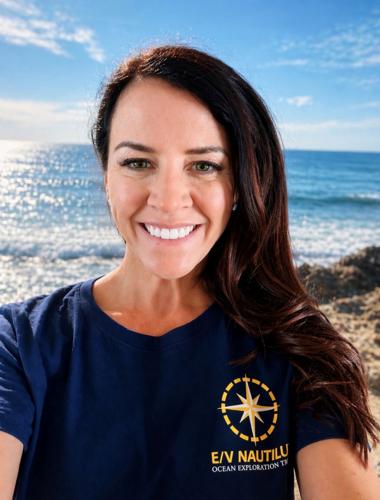
Cosme will join the Nautilus — the exploration vessel is named after Jules Verne’s legendary fictional submarine — on its 23-day expedition that will use underwater robots, remotely operated vehicles (ROVs), to map and explore deep-sea terrain, including abyssal plain habitats, seamounts and other mysterious regions 4,000 meters below the surface.
People are also reading…

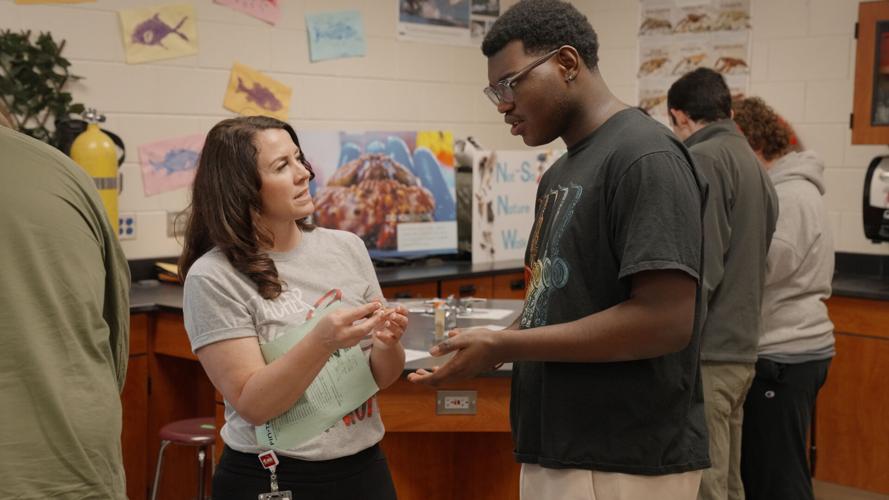
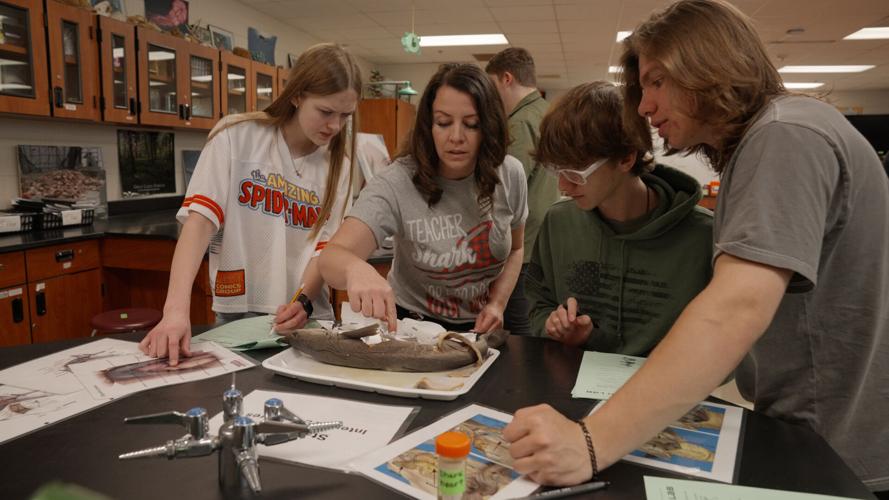
Crown Point High School teacher Ashley Cosme, shown here helping students dissect a small shark, will be part of an upcoming deep-sea expedition to map the seafloor near the Mariana Trench.
As part of the program, run by the Ocean Exploration Trust, Cosme will have a chance to work alongside Robert Ballard, the legendary oceanographer who discovered the wreck of the Titanic.
“I didn’t know I was sailing with Ballard until I pulled up the expedition details in front of our class on a big screen in the classroom,” Cosme said. “They saw my reaction live. I was so excited, the students were excited.”
As the team’s science communications fellow, Cosme will run the “Ship to Shore” program, which allows teachers and members of the public to schedule times to virtually meet and interact with the crew and to follow along as the underwater robot scans the seabed.
“My job is to get communication going,” Cosme said. “It’s live-streamed, so anyone can watch the ROV cameras as they’re deployed. Everything we see on the ocean floor, the public is also seeing. Let’s say people back in Crown Point want to know what species of coral we just passed. I’m navigating that conversation.”

Crown Point High School teacher Ashley Cosme will be part of an upcoming deep-sea expedition to map the seafloor near the Mariana Trench.
Cosme and her students are already familiar with the OET and Nautilus “Ship to Shore” Zoom calls, where educators and classrooms can talk and interact with the scientists on board the ship. This summer, Cosme’s students will still do that, but Cosme herself will now be on the other side of the camera.
“I just felt inspired,” Cosme said. “I told myself, this year, I am going to go for it. I applied and here we are. I think the students are thrilled they can do a Zoom call and communicate with me while I’m out in the field.”
Cosme’s love for the sea and marine biology started much closer to home, where, as a child, she would do flyovers of Lake Michigan with her father, a private pilot.

Crown Point High School teacher Ashley Cosme will be part of an upcoming deep-sea expedition to map the seafloor near the Mariana Trench.
That led to a degree in marine biology at Eckerd College in St. Petersburg, Florida. Cosme is also an experienced open water diver.
“I was always curious about what was below the surface,” Cosme said. “As a teacher, my goal is to get the kids out there and bring the Great Lakes, and the ocean, into my classroom.”
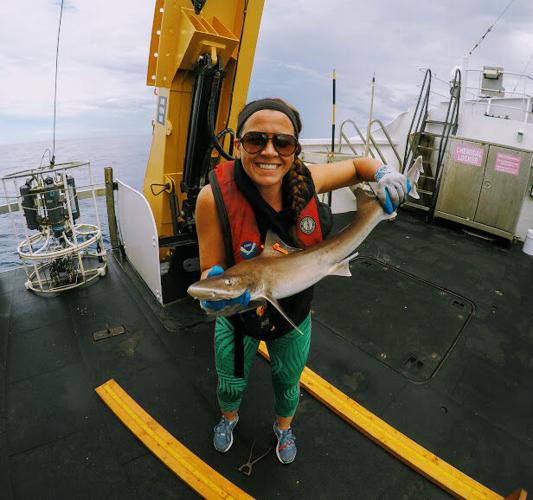
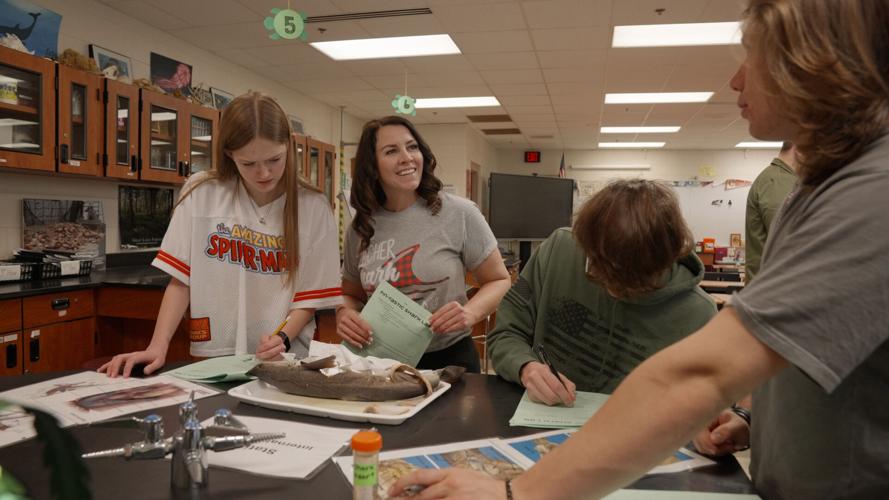
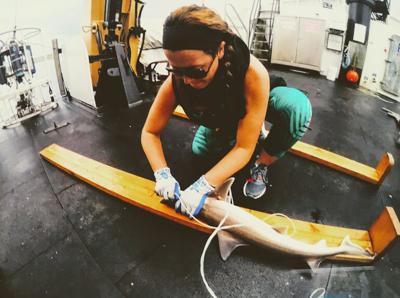
The curriculum has allowed Cosme to do several fun activities with students, including dissecting sharks.
“The kids love the animals,” Cosme said. “I do think it's important they also understand the water chemistry, the geology of the ocean. The physics of the ocean drives how the animals live.”

Crown Point High School teacher Ashley Cosme will be part of an upcoming deep-sea expedition to map the seafloor near the Mariana Trench.
The Nautilus' ROV may find a deep-sea menagerie a whole lot stranger than sharks. The deep-sea trenches are home to hydrothermal vents, or “black smokers” (also discovered by Ballard) that support all kinds of exotic, even alien-seeming, life forms. The area the ROVs will explore and map is near the Mariana Trench, the deepest part of the ocean, where the seafloor is constantly being subducted via plate tectonics and creating new mountain chains.
“It’s just really great to explore what new species are down there,” Cosme said. “I could be on a mission that discovers an animal that has never been seen before. That would be really neat!”
Cosme was one of 14 fellows selected to take part in OET expeditions this summer. The Nautilus team includes scientists, ROV pilots, engineers and college interns as well as Cosme. In addition to the Mariana Islands research, the OET also has fellows taking part in voyages near Wake Island and the Hawaiian Islands. The Wake Island leg of the expedition will get a chance to investigate sunken World War II-era ships and submarines that went down decades ago.
As Cosme prepares — the expedition included training in California on the geology of the sea floor — Cosme said she is brainstorming ideas about how to bring the experience back to students and the greater Northwest Indiana community.
“This is a tremendous honor and accomplishment for Ashley,” said Crown Point High School Principal Russ Marcinek. “She is an outstanding teacher who is passionate about her students and subject matter. We are proud of Ashley and the way she represents our teachers and school.”
Crown Point High School teacher Ashley Cosme, shown here helping students dissect a small shark, will be part of an upcoming deep-sea expedition to map the seafloor near the Mariana Trench.
Cosme said that she hopes her work inspires her students and others to see the breadth of possibilities within the field of oceanography.
“People think of marine biology as training dolphins,” Cosme said. “There are so many topics and careers out there within the field. So many things kids can do when they grow up. I’m just trying to pique their interest. Maybe they will want to learn how to build ROVs. Or check out the deep-sea portals. I’m really excited about this mission.”
The Nautilus expedition will start its 23-day deep-sea Mariana expedition on June 28. Interested readers can learn more and interact with the team via nautiluslive.org.