




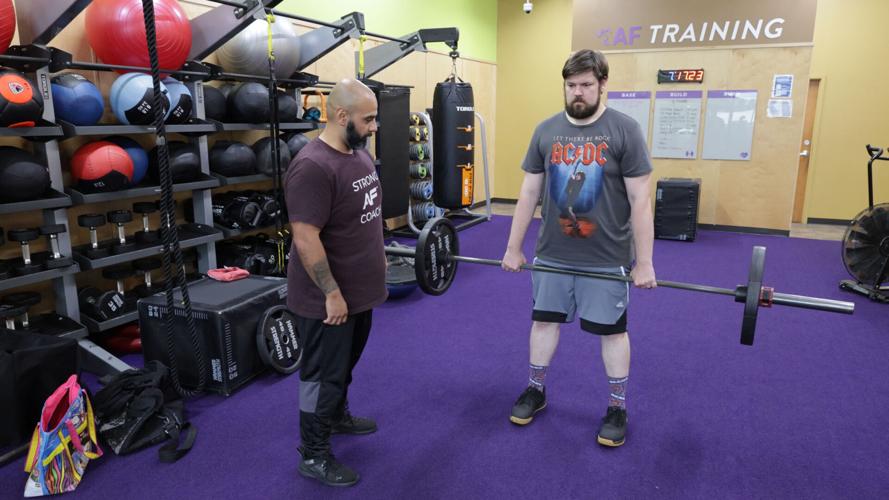
Eric White, regional coach at Anytime Fitness, talks about free weights while trainer Steve Valdez shows client and singer Dave Drejas how to execute a dead lift.
“No one likes it when the singer is out of breath,” said David Drejas, singer and guitarist for OUTDrejas, which bills itself as an outrageous rock 'n' roll act. “I have noticed that training with free weights has helped me perform better on stage. My cardio and overall health have improved greatly since using free weights to deadlift and squat, allowing me to run and dance more easily while singing and playing guitar.”
“Free weights always have been popular among the training community,” said Ken Croner, personal trainer at Community Hospital Fitness Pointe in Munster. "French and German universities offered weight training classes as part of their curriculum from the mid-16th Century, and the use of free weights in physical rehabilitation started in the early 18th Century. They have stood the test of time.”
“Free weights are making a strong comeback in fitness routines,” said Eric White, regional coach for eight Anytime Fitness locations in Northwest Indiana. “Free weights include dumbbells, barbells, kettlebells and weight plates. Unlike machines, free weights allow for a full range of motion, engaging multiple muscle groups and stabilizer muscles. They are versatile and can be used for various exercises such as squats, deadlifts, bench presses and bicep curls.”
People are also reading…
Using free weights can significantly improve muscle strength, endurance and overall fitness by building lean muscle mass, burning calories and improving bone density, according to White. “Additionally, because free weight exercises require balance and coordination, they also enhance core stability and functional fitness, which is crucial for everyday activities,” White said.
According to the Centers for Disease Control and Prevention, weightlifting can improve overall stability and reduce the risk of falls, a primary cause of injury in adults age 65 and older.
According to Croner, free weight exercises also benefit the body's joints, which are essential for supporting our daily movements. “Free weights do a tremendous job of developing joint strength because they have to be balanced by the individual in any movement they perform, “ said Croner. “The controlling action of moving the weight builds tendon and ligament strength in the joints that are being used."
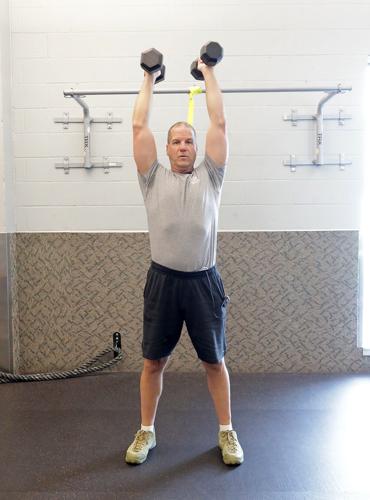
Kasia Topor, bodybuilder and owner of ProCoreFitness, discusses the benefits of using free weights while demonstrating a shoulder press and chest press.
“I am a big supporter of free weight exercises for most of my clients because they can adjust them to their comfort zone,” said Kasia Topor, International Federation of Body Building Pro and owner of ProCoreFitness in New Lenox. Noting that exercises can be adapted to accommodate an injury, Topor recommends working with a professional trainer to learn how to use free weights safely. “I tell my clients, ‘I cannot change your life in one session, but give me six months, and I will change your life,’ ” said Topor.
It's crucial to start with proper guidance and a specific plan, according to White. “It's important to follow a structured program that progressively challenges your muscles. Start with lighter weights to master the form of each exercise. Gradually increase the weight as you become more comfortable and your strength improves,” said White.
“I would not have been successful in doing more complex lifts like a deadlift without the expert help of my trainer, Steve Valdez at Anytime Fitness,” said Drejas. “Steve has been training me to do complex exercises involving free weights like deadlifts, and I have noticed more health benefits than just using machines to train.”
If you're comfortable using free weights and prefer to exercise at home, White recommends starting with a basic set of adjustable dumbbells, a barbell with weight plates and a sturdy bench. Kettlebells and resistance bands are also beneficial.
Croner added that you can improvise in a home training program. “The novice trainee can use soup cans, books, bricks, rocks — any object that will provide resistance will do the job.”
When getting started, Topor, Croner and White recommend training three days a week for the first six months. Begin with light weights and start with two sets of 12 repetitions for each exercise in the first two weeks. Then, progress to three sets of 12 repetitions for each exercise in the following two weeks. Focus on proper movement and form during the first set to warm up. Gradually increase the resistance by adding more weight, reps or sets as you build strength.
“I started training with free weights about six months ago,” said Drejas, “and my favorite aspect has been seeing quicker and more meaningful results versus previous training methods.”


